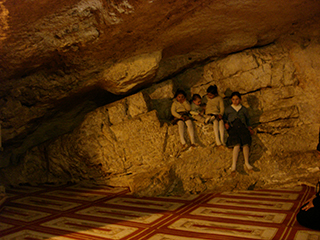
Photographs: Mustafa Aksay
The tradition that began with the hijra (emigration) of Adam and our mother Eve to the World, and continued with the emigrations of Noah, Lot, Salih, of Abraham, who said "I am an emigrant to my Lord (one who emigrates) (al-Ankabut, 26)", of Joseph, Moses, Jonah and finally of our Master (the Prophet), manifested itself in the journey of the first Companions, the first emigrants, from Mecca to Abyssinia, which was their Medina; in the hijra of Uways al-Qarani and of Ibrahim ibn Adham; in that of Muhyiddin Ibn Arabi from Andalusia to Konya and Damascus; and in Rumi as a hijra of love and affection from Balkh, his Mecca, to Konya, his Medina. Alongside our Master's hijra from Mecca to Medina, the event of the Mi'raj (Ascension) is also, in the fullest sense, a true hijra (hijra-i haqiqi).
During the Mi'raj, God Almighty at times showed our Master the majesty of His Oneness (ahadiyya), and at times manifested Himself with the beauty of His Self-Sufficiency (samadaniyya).
In the words of İsmail Hakkı Bursevi:
" … but in the station of contemplation (mushahada), wherever they may be, there is no veil for them. It is for this reason that the Mi'raj of His Excellency the Prophet (peace and blessings be upon him) was for the journey through the signs of the angelic realm (malakut); otherwise, even while in his noble chamber he was capable of contemplating the Divine Beauty."[1]
It is narrated that the reality of the event called "sealing the foot and standing", a rule of conduct in the Sufi orders, took place during the Mi'raj. "When the Prophet (peace and blessings be upon him), during the Mi'raj, reached the station of 'two bows' length' (qaba qawsayn), passed through seventy thousand veils with the Rafraf, and fell into a state of sama' and rapture (istighraq) in the Vision of God, the Necessary Being, Exalted be He, addressed him: 'Stop, O Muhammad!' When the Messenger (peace and blessings be upon him) asked, 'There is no place to stand; where shall I stop?', God Almighty said: 'Stand by placing your right foot upon your left foot.' Our Master obeyed this command. For this reason, dervishes follow the sunna of the Prophet (peace and blessings be upon him) by 'becoming sealed at the dâr', that is, by standing with the right foot placed upon the left."[2] In this event that took place during the Mi'raj, Ahmadiyya formed the ground for Muhammadiyya, while Muhammadiyya, by attaining the Vision of God, took precedence over Ahmadiyya. A path was opened from the realm of possibility and the realm of humanity (nasut), which have time and ground, to the realm of divinity (lahut), which is without time, without place and without ground; and the Mi'raj and union (wuslat) at the station of qaba qawsayn came about in this way. The Sufi principle of 'nazar bar qadam' (keeping the gaze on the foot) is also owing to this secret.
Ferid Kam Bey gave voice to this secret of the Mi'raj in the following quatrain:
Had the pen of Divine Power brought forth one like you,
You would have been the finest couplet in the poem of the world;
You are the matchless line of creation since pre-eternity,
You remained unique in the divan of "Be, and it is."
On the night of the Mi'raj, our Master was taken by Gabriel from the house of Umm Hani, where he had taken refuge after returning from Ta'if, and brought to the Haram al-Sharif. A mantle (hırka) of light was placed upon his back and he was clothed in it there; a ruby belt was fastened around him, and he was given a staff and sandals of emerald. He was made to perform ablution from the well of Zamzam and to circumambulate the Kaaba seven times; he prayed two rak'ahs at the Station of Abraham, came and sat at the Hatim, and from there came to the Bayt al-Maqdis in Jerusalem and began his ascension (uruj). Gabriel (peace be upon him) clothed our Master the Messenger of God (peace and blessings be upon him) at the Kaaba so that he might manifest his vicegerency (khilafa) and prophethood. The granting of khilafa to the seeker (salik) and his being clothed in the mantle (garment) in the Sufi orders is likewise practiced in conformity with this tradition[3].
Our Master, the Pride of the Universe, before the Mi'raj, led all the prophets as imam in the Masjid al-Aqsa and led them in a two-rak'ah prayer. The adhan for this prayer was recited by Gabriel, and this was the first adhan ever recited. The Haram al-Sharif area in Jerusalem, where the Dome of the Rock and the Masjid al-Aqsa stand, is, in terms of quantity as well, exactly large enough to hold 124,000 prophets.
Sufi sources narrate that our Master made the Mi'raj thirty-four times; that when he returned from the Mi'raj there was a crown and a green turban upon his head; that when the Companions saw him in that attire they understood that he had returned from the Mi'raj and congratulated him; and that the Hırka-i Şerif (Holy Mantle) was put on him during the Mi'raj together with the other garments. As to what meaning the garments such as the mantle, crown and turban, and the wearing of them, correspond to, Muhyiddin Ibn Arabi said in al-Futuhat al-Makkiyya: "In our view the mantle is nothing but companionship (suhba), training, being instilled with courtesy (adab), and good character, and this is called the garment of piety (taqwa)." In his work titled Nasab al-Khirqa, he says of the "mantle": "The origin of this garment, as far as God has cast it into my secret and breathed it into my heart, is this: God has clothed Himself with the heart of His servant." For in the hadith qudsi it is said: "I did not fit into the heavens and the earth; I fitted into the heart of My believing servant." The verse of the Holy Qur'an, "O children of Adam! We have sent down to you clothing to cover your nakedness, and adornment; but the garment of piety, that is best. That is among the signs of God, that perhaps they will reflect and take heed." (al-A'raf, 26), and the words of Yunus Emre:
"What they call dervishhood is not the mantle and the crown;
He whose heart is a dervish has no need of a mantle."
point to the same meaning. In truth, in accordance with the hadith "Die before you die", the dervish buries his ego (nafs) in his mantle, which he likens to a grave, and accomplishes his own hijra.
When the "hijra" began, which, through the secret of nearness (qurbiyya), the essence of individual wisdom, born of the seclusion and solitude in the Cave of Hira on the Mountain of Light, is the name of pursuing the secret of being and non-being by leaving everything behind and shouldering anew the burden of all humanity for God and Truth in another land and another milieu, a new era that founded and kneaded a civilization had begun at the first stop, the Cave of Thawr.
At the beginning of the hijra, when our Master and Abu Bakr took refuge in the Cave of Thawr, Kurz ibn Alqama, the guide and tracker of the polytheists pursuing them, said, "Here the tracks end." To protect these blessed guests in the Cave of Thawr from the polytheists, by the divine will a spider had woven its web across the mouth of the cave and two doves had built a nest. After leaving Mecca at the beginning of the hijra, with the spider's web enclosing the hollow of the cave on Mount Thawr, where they stayed for three days, a new era had begun in this first space of Islamic Civilization. For this reason, and on account of this secret, the smallest unit of length chosen as the unit (wahid-i qiyasi) in Islamic Art and Architecture is the spider's thread, called "tar-i ankabut". The two doves, for their part, nested there of their own accord, in a way recalling the story of Abraham, who for the reassurance of his heart said, "My Lord! Show me how You give life to the dead."[4] As expressed in the verse "And indeed the frailest of houses is the spider's house, if they only knew" (al-Ankabut, 41), the strongest protection was being made with the weakest thing, and our Master's submission, "O Abu Bakr! Do not grieve! Surely God Almighty is with us", transcended time and found an immediate response.
The lines written by Yahya Kemal in February 1921, "This state has two spiritual foundations: the adhan that the Conqueror (Fatih) had recited from the minarets of Hagia Sophia, which is still being recited; and the Qur'an that Selim had recited before the Hırka-i Saadet (Mantle of Felicity), which is still being recited", are a marvelous expression of how time lived within the past passes on to the future while being lived in the "now". These two criteria are the conceptions of "revelation" (the Holy Qur'an) and the "Sunna", the greatest trust the Prophet left to humanity, around which the sphere of Islamic Civilization took shape.
It was you who made known who God is;
Without you, who would have known of Him?
Fuzuli
Within this framework, the path to faith in God is faith in the Most Noble Messenger; it is a goal, and the true purpose of the wisdom of creation, that requires knowing him with certainty and making his deeds and words one's own. Just as those bound to the Prophet bear the responsibility of following him and submitting to his commands and prohibitions, they are also obliged to follow his conduct and accept him as the model to be emulated.
The Holy Qur'an relates the measure of a person's love for God to following the Prophet and taking him as a model, and God Almighty declares this through the tongue of the Most Noble Messenger in the verse: "Say: If you love God, then follow me, so that God will love you and forgive your sins. God is All-Forgiving, Most Merciful" (Al 'Imran 3/31).
This world is a mirror, everything subsists through God (al-Haqq);
In the mirror of Muhammad, God is ever seen.
The Andalusian scholar Ibn Hazm states that those who wish to attain the good of the hereafter, worldly wisdom, a life of uprightness and beauty of character, and to be adorned with virtue, should take the Prophet as their example[5]. The Companions, who considered the exemplariness of the Most Noble Messenger to be related not only to religious commands but also to the deep reverence felt for his memory and the sense of loyalty cherished toward him, and the generations that followed them, preserved with great care the items that belonged to or were used by the Prophet, and also used them for healing and for blessing (tabarruk)[6].
Imam al-Bukhari (d. 256/870), known for his work al-Jami' al-Sahih, regarded as the most reliable book after the Holy Qur'an, opened a chapter titled "Chapter on the armor, staff, sword, cup and seal of the Prophet, the division of which is not mentioned, some of which were used and preserved by the caliphs after him, and on his hair, sandals and vessels, from which the Companions and others continued to seek blessing after his passing to the realm of Divine Beauty"[7], and thereby cites the understanding that showing reverence to the sacred relics is a sign of love for the Prophet[8]. Umar ibn Abd al-Aziz kept, in a chamber next to his room, a bed of the Most Noble Messenger woven from palm fibers, a leather cushion stuffed with palm fiber, a velvet cover that he used as a quilt, permeated with the scent of the Prophet and smelling sweeter than musk, a large plate, a water bowl, a garment, a hand mill and a quiver; he made it his custom to visit them daily and to have those who came to him visit them as well.[9]
Of the garments worn by the Prophet, two mantles called burda that have come down to the present day are preserved in Istanbul. Of these, the one the Most Noble Messenger gave as a gift to Ka'b ibn Zuhayr, one of his Companions and the poet of the Qasidat al-Burda, and which is exhibited today in Topkapı Palace, became famous as the "Hırka-i Saadet" (Mantle of Felicity), while the one the Prophet bequeathed to be given to Uways al-Qarani, and which gives its name to the mosque in Fatih where it is kept, became famous as the "Hırka-i Şerif" (Holy Mantle). Of these mantles, whose names are sometimes used interchangeably, the Hırka-i Saadet, because it was used by the caliphs as a sign of sovereignty, found extensive place in hadith and history books, while the Hırka-i Şerif, since it was preserved by private individuals, did not feature much in early written sources.
Early sources do not contain sufficient information on the life of Uways al-Qarani in Yemen, on how he became a Muslim, or on his life in Kufa, where he later settled, his death and his personality. Nevertheless, the limited information found in early hadith, history and tabaqat (biographical) works, expanded by general hagiographies (manaqibnama), above all the Tadhkirat al-Awliya written by Farid al-Din Attar at the beginning of the 13th century, gave rise to an extensive literature on Uways al-Qarani. From this information, which is important in that it completes the gaps concerning the life and personality of Uways al-Qarani and reveals how he was known among the people, it is understood that he accepted Islam through the Muslims who went to Yemen to preach Islam. Uways al-Qarani, who earned his living as a camel herder in Yemen, greatly longed, after becoming a Muslim, to go to Medina and visit the Prophet, but the existence of his elderly mother did not allow this[10]. Meanwhile, finding an opportunity, he obtained his mother's permission for a short absence and came to Medina; but since he did not find the Most Noble Messenger at home that day, he could not meet him, and in order to keep his mother's consent, he was obliged to return to Yemen the same day in great sorrow and grief of separation.
The Prophet (peace and blessings be upon him) said: "When I was raised to the seventh heaven, after God the Majestic addressed me, my friend Gabriel took me by the hand and brought me into Paradise. There I saw a palace of red ruby, and within it a chest which, along with its lock, was made of light. I said, 'My friend Gabriel, what is inside this chest?' Gabriel said, 'In it is the source of pride for you and for your community after you until the Day of Judgment: the mantle of poverty,' and he opened the chest. Taking the mantle of poverty out of the chest, he clothed me in it and said: 'O Messenger of God (peace and blessings be upon him)! God Almighty commanded me to clothe you in it. And you, give it only to those who deserve it.'"[11]
One night, when the palace of Umm Hani
Had become the sky of that moon,
What a night it was! The trustee of mercy,
Elder of the sanctuary of the Presence's precinct,
Like Bilal, possessor of gnosis,
The light of faith within a black light;
As though on that night of glorious deeds
It was Uways of Qaran whose light appeared.
He came to rub his face upon the dust of those blessed feet;
They found themselves invited to the heights.
Şeyh Galib
Shortly before his passing, the Prophet took off his mantle and handed it to Umar and Ali, bequeathing that they give it to Uways al-Qarani, whom he had been unable to meet even though Uways had come as far as Medina[12]. Uways al-Qarani, who went on pilgrimage during the caliphate of Umar, settled in Kufa after meeting the caliph[13]. It is understood that Umar and Ali fulfilled the Prophet's bequest by handing over the Hırka-i Şerif to Uways al-Qarani in Medina or Kufa, or by going to Qaran in Yemen[14]. Umar's request for prayers from Uways al-Qarani on the recommendation of the Prophet, and his taking part in the Battle of Siffin (37/657) in the ranks of Ali, show that he was in close relations with the first caliphs. Although there is a general opinion that he was martyred at the Battle of Siffin, where he was with Ali, there are also narrations that he died during a campaign to Azerbaijan in the time of Umar[15].
Uways al-Qarani became the foremost exemplar of love and submission, of believing without seeing, through hearing without being addressed face to face (in person), with the sincerity of the station of ihsan. Uways al-Qarani, of whom the Prophet said, "The best of the Tabi'un (Followers) is Uways"[16], is counted among the great Tabi'un called "mukhadram", who became Muslim during the lifetime of the Most Noble Messenger yet could not see him. Because Uways al-Qarani was spiritually trained without having seen the Prophet, and because our Master the Prophet bequeathed his blessed mantle to him, the spiritual lineage of Uways al-Qarani came to be known as the Uwaysiyya, and it also prepared the ground for the emergence of a Sufi order called Uwaysism[17].
In Turkish-Islamic culture, Uways al-Qarani is regarded as the patron saint (pir) of prayer-bead making, and in the shops where this craft was practiced, plaques were hung bearing the words, "Every day our workbench opens with the Basmala / Hazrat Uways al-Qarani is our patron and our master"[18]. The narration that, upon hearing that the blessed teeth of the Prophet had been broken ("martyred") during the Battle of Uhud, he broke his own thirty-two teeth out of his excessive love for our Master, completing this number to thirty-three together with the tooth of the Most Noble Messenger, is well known in oral culture. One interpretation concerning prayer beads is as follows: "Since the radiant[20] prophetic light of our Master, the place of descent[19] of the Secrets of God, shone forth into this world of witnessing from his very pure being, and since his pure being, as the quintessence of the universe, has been from pre-eternity, with all its cells and atoms, a 'glorification of God', he did not himself use prayer beads, but he encouraged them, saying 'What a fine reminder it is.' Since he himself never forgot the Creator even for a moment, he had no need of remembering or of a reminder."
The oldest records concerning the Hırka-i Şerif are found in al-Tabaqat al-Kubra by Muhammad ibn Sa'd (d. 230/845), a scholar of hadith, sira, history and genealogy (ansab), the first of the tabaqat books and the oldest of those that have come down to our time, and in the work titled al-Jami' al-Sahih by Muslim ibn al-Hajjaj (d. 261/875), which, together with Sahih al-Bukhari, has been regarded since the time it was written as one of the two most reliable sources after the Holy Qur'an. In these works, Usayr ibn Jabir, who relates the virtues of Uways al-Qarani, records the following: "His garment was of a striped cloth. Whoever among the people saw him could not help saying, 'I wonder where Uways found this mantle (burda)?'"[21].
Since Uways al-Qarani had no heir after his death, the Hırka-i Şerif passed to his brother Shihab al-Din al-Uwaysi. Thereafter the Hırka-i Şerif was preserved by the family descended from him. The family resided for a time in Iraq and the Southeastern Anatolia region, and after certain political events that took place there, they migrated to and settled in Kuşadası in the time of Ziver al-Uwaysi of the same family. The date on which the Hırka-i Şerif came to Kuşadası is not known exactly. Nevertheless, because they possessed the Prophet's mantle, the family was always shown reverence wherever they went and enjoyed great esteem in the eyes of the state and the people. In 1611, at the request of Ahmed I, the Uways family came from Kuşadası to Istanbul and settled there. Although there are records that the family settled around Yavuzselim, the information that they resided in a house opposite the Akseki Masjid, to the northeast of the present Hırka-i Şerif Mosque, must be more accurate. Indeed, the information that Grand Vizier Çorlulu Ali Pasha had a masonry chamber built for the preservation of the Hırka-i Şerif, with an imaret (soup kitchen) and a fountain adjoining it, confirms this. It is known that the Uwaysis who settled in Istanbul opened the Hırka-i Şerif to visitors during the months of Ramadan, first in their residence and, from the beginning of the 18th century, in the chamber built by Çorlulu Ali Pasha[22]. After Sultan Abdülhamid I had a special chamber consisting of a single room built in the northern courtyard of the Hırka-i Şerif Mosque in the Fatih district (1780), the Hırka-i Şerif began to be preserved there[23]. This chamber, known as the Small Hırka-i Şerif Chamber or the Old Hırka-i Şerif Room, was renovated by Mahmud II in 1812. Sultan Abdülmecid, deciding to build a mosque and a place of visitation worthy of the glory of this blessed trust, had the mosque known by the same name built in 1851. The Hırka-i Şerif is preserved in Fatih, in a special room above the mihrab on the upper floor of the Hırka-i Şerif Mosque, together with the belt of Uways al-Qarani and his four-panel[24] headgear made from our Master's blessed pashmaks (felt slippers).
Let the communities visit: this is the mantle more precious than life,
This is Mustafa's gift bestowed upon His Excellency Uways.
Rub your darkened face upon its honored threshold in supplication,
This is the station of the pure mantle of the Beloved of the Almighty.
Abdurrahman Şeref Güzelyazıcı
The Hırka-i Şerif Mosque has an octagonal plan, like the Dome of the Rock in Jerusalem, from where our Master ascended in the Mi'raj. The "Mantle" he bestowed as a gift upon Uways al-Qarani is also made up of eight pieces of fabric. Various sources mention, together with the verse of the Holy Qur'an "On that day eight angels (hamalat al-'arsh) will bear the Throne of your Lord" (al-Haqqa, 17), that Paradise, which he visited during the Mi'raj, also has eight gates.
The Hırka-i Şerif is the mantle that he is narrated to have been wearing during the Mi'raj of our Master (peace and blessings be upon him). In its patterns, its making and its manufacturing technique, it is not made of a "woven fabric" like the Hırka-i Saadet in Topkapı Palace; rather, its embroidery technique is intricate, difficult and complex, to a degree that makes it a subject for scholarly research. Even today it is doubtful whether such embroidery of this fineness could be produced. The opinion of the textile experts on the scientific committee during the conservation of the Hırka-i Şerif is also along these lines.
Many sources wrongly state that the Hırka-i Şerif is made of "wool". As determined by microscopic analyses, "linen, cotton and silk" were used together. Between two fabrics of finely woven linen, cotton threads in thousands of small pieces pass over and under one another to form the patterns. Without disturbing the patterns thus formed, the two separate linen fabrics, below and above, are bound to each other with fine silk threads around the holes formed along these small cotton pieces. Around the circular fixing holes, the silk threads forming rings are knitted in an intricate, spiraling manner, such that even today it is doubtful whether a fabric of this layered technique and fineness could be produced, even with the use of technology.
Its inside is the ocean of Unity, its face the desert of multiplicity;
Whoever sees its face sees: amid the strangers the Beloved appears.
Niyazi Mısri
In the examinations, analyses and laboratory studies carried out with a stereo microscope and an optical microscope on 26 samples at the Department of Microbiology and Clinical Microbiology of the Istanbul University Cerrahpaşa Faculty of Medicine, no bacteria or fungi were found, and it was established that, despite the passage of time, no damage caused by them had occurred.
When considered within the framework of Islamic Art and Architecture, the mantle of our Master (the Prophet) offers clues regarding the emergence of these arts. With the mosaics of the Dome of the Rock in Jerusalem and the Umayyad Mosque in Damascus, the first works of Islamic architecture, two decorative elements emerged that also extended into later periods. The first is the making of references through the stylization of real forms, using natural (naturalistic) forms within stylized (anti-naturalistic) combinations; the second is a continuous variety that alludes to infinity[25]. From the first century of the Hijra onward, throughout the entire Islamic world including Andalusia, intricate hendesî (geometric) patterns, in forms that had matured within a short time and as the most difficult compositions of geometry, began to be used in all Islamic architecture and arts. How this mature variety emerged in such a short time has always been a subject of curiosity from the standpoint of art history. The first examples of geometric patterns alluding to infinity, found on the mantle that our Master bequeathed and presented to Hazrat Uways al-Qarani (Veysel Karanî), led us to reflect on this subject.
The composition and synthesis brought forth by works of art that are the product of a civilization, together with the truth to which they refer and the attitude and style to which they point, depict the consciousness of the cosmos, the perception of the universe, the way of looking at things and the conception of civilization. This shared world of mentality and sense of belonging defines the civilizational world to which one belongs. In this way, the building of a civilization is reflected as identity and way of life.
Just as the "ney" (reed flute) laments separation because it was torn from the reed bed, and just as the origin of man does not belong to this world, so too the Kaaba is a sacred structure laden with the inner meanings of tawhid (divine unity) and Divine Power, a sign of the world beyond. The re-establishment of the Kaaba, the first temple of humanity, as the qibla for Prophet Muhammad (PBUH), and the turning to the Kaaba from the sanctuary that, while being the qibla of other heavenly religions such as Judaism and Christianity, had also been designated as the "qibla" in the first period of Islam, namely Masjid al-Aqsa, is a divine confirmation that Prophet Muhammad (PBUH) is the "Khatam al-Anbiya", that is, the "Last Prophet", and that Islam is the "Last True Religion". That the Mi'raj (Ascension) of our Master began with the event of the Isra, his journey to Masjid al-Aqsa, and that he ascended to the Mi'raj from there, is also an indication of this truth.
The belief in tawhid of the Islamic revelation brought forth a conception of art which, in reflecting the spiritual realm onto the world, uses not the forms of created things but geometry, rhythms and fundamental structures that find their reflection in the essence of matter; which expresses quality and personality rather than quantity; and which is not müşahhas (concrete) but mücerred (abstract). Turkish-Islamic art, beyond being a mücerred (abstract) art that lends nobility to matter, is a conception of art that, as reflections of heavenly wisdom, relates "kesret" to "vahdet" (multiplicity to unity) by means of geometric-mathematical forms and sequences.
When the universe and all created beings, which are the signs (ayat) of God, are perceived in this way, sciences such as physics, chemistry, astronomy and the like also become "hikmah" (wisdom) expressing sanctity. It is for this reason that a hadith says: "Wisdom is the lost property of the believer. Wherever he finds it, he takes it." By perceiving the divine knowledge veiled in the depths of the visible, man discovers it and invents new things. In the Islamic arts, what is "müşahhas" (concrete) exists in order to express what is "mücerred" (abstract). Its counterpart in literature is "mecaz" (figurative expression), "mazmun" (poetic conceit) and "istiâre" (metaphor). What is truly contemplated is not the universe itself, but the perceptions in it, the patterns, and the essence and truth of the pattern. Each pattern is an "ayah" (sign) among the signs of God. For this reason, the patterns used in mosques were chosen from the perspective of the relationship between the pattern and the pattern-maker, between the cause and the Causer. For this reason, nature is contemplated not directly but through allusion and reference. Man's existence, and existence and things themselves, are the greatest of the hijabs (veils) between "al-Haqq" (the Real), "truth" and "man". That is why, by pointing to the warâ of existence (what lies beyond it) and to the warâ of the warâ (the beyond of the beyond), "transience" is concealed (covered), and reference is invariably made to "infinity" and "baqa" (permanence). Through the pattern, the pattern-maker is intended. Things, in the way they appear, do not show man their own truth. They become worthy of contemplation only after they are abstracted from their appearance and purified of what is transient. For the man who knows the purpose of creation, space is a window opening onto the realm of spacelessness. Man too is a space that has contained lâmekân (spacelessness) within itself. Space is an allusion to the void within the walls, the inner character (sîret) within the outer form (sûret), baqa within fana (infinity within nothingness). In truth, forms, things and all existence are a mirror to the meaning of matter, to the sîret of the sûret, to the anfus (inner horizons) of the âfâq (outer horizons). Existence, too, does not become "time"; it becomes "the moment". Time is relative, dimensions are nâmütenâhî (infinite)…
This understanding brought about stylization (stylization) in the Islamic arts through the consciousness of condensation (teksîf), composition (terkib) and abstraction (tecrîd). For this reason, by discovering the hidden geometry present in nature, the Turkish-Islamic arts present to human perception, through the style of abstraction, the hidden worlds carefully veiled in the essence of things and the geometry of their construction; they grant to things, to what is visible, to personality and identity, a meaning and quiddity beyond values. Just as the purification (istifâ) of humankind reached perfection in Prophet Muhammad Mustafa (the purified, the chosen one) (PBUH), the pinnacle of humanity, so too in the civilization of the religion he brought, things are viewed through this window of purification (istifâ) and abstraction (tecrîd). For this reason, painting, sculpture, theatre and the novel in their Western sense, which are the manifestation and expression not of truth but of falsehood, never existed in the Islamic arts. Instead, there are miniature, calligraphy, illumination, the performing arts (temâşâ) and tales. That is to say, an understanding and perception was preferred that attributes value to form and appearance only in proportion to their transience, and gives precedence to meaning and inner essence. This view of the world and of things in Islamic Civilization, which is a high culture and civilization, and in its arts, is the expression of the fact that, by correctly grasping the reality of life and death through the balance between this world and the hereafter, alongside the welfare of humanity, its peace and happiness are also of extraordinary importance[26].
From Love, Muhammad came into being;
Without Muhammad, what comes of Love?
BIBLIOGRAPHY
Ahmet Yaşar Ocak, Veysel Karanî ve Üveysîlik, Istanbul 1982;
El-Kuraşî, İbn Reddâd Şihâbüddîn Ahmed, Telhîsu Kavâidil-Vâfiye fî Asli Hükmi’l Hırka es-Sûfiyye, Süleymaniye Library, no.: 3747/11
Richard Ettinghausen, Islamic Art and Architecture 650-1250, New Haven and London, 2001.
Ferîdüddin Attâr, Tezkiretü’l-evliyâ (ed. M. Edîb el-Câder), Damascus 2009;
Fikret Sarıcaoğlu, Kendi Kaleminden Bir Padişahın Portresi: Sultan I. Abdülhamid (1774-1789), Istanbul, 2001.
Halife b. Hayyât, et-Tabakat (ed. Ekrem Ziyâ el-Ömerî), Riyadh 1982;
Haşim Köprülü [Üveysî], Hırka-i Şerif ve Veysel Karanî, Istanbul 1975;
Hilmi Aydın, Hırka-I Saadet Dairesi ve Mukaddes Emanetler, Istanbul, 2004.
İbn Hacer, el-İsâbe (ed. Âdil Ahmed Abdülmevcûd et al.), Beirut 1995;
İbn Sa‘d, et-Tabakatü’l-kübrâ (ed. M. Abdülkadir Atâ), Beirut 1990;
İbnü’l-Cevzî, Sıfatü’s-safve (ed. Mahmûd Fâhûrî - M. Revvâs Kal‘acî), Beirut 1979;
idem, el-Vefâ bi-ahvâli'l-Mustafâ (ed. Mustafa Abdülvâhid), Cairo 1996;
Kâşâni, Te’vilât-ı Kâşâniyye, Ankara, 1987.
Muharrem Hilmi Şenalp, “In the Light of the Mosque Question: What Should Turkey’s Vision of Culture and Civilization Be?” (Cami Meselesi Işığında; Türkiye’nin Kültür ve Medeniyet Vizyonu Ne Olmalıdır?), 2012.
Murtaza ez-Zebîdî, İkdü’l-cevheri’s-semîn (photocopy of the M. Tâvît et-Tancî copy), ISAM Library, no. 4622;
Mustafa Çağrıcı, “Muhammed (sav)”, DİA, 30, 445;
M. Baha Tanman, “Hırka-ı Şerif Camii”, DİA, 17, 378-379;
Mehmed Serhan Tayşî, Tarîkat Kıyafetleri, Istanbul, 2006.
Nebi Bozkurt, “Tesbih”, DİA, 40, 531;
idem, “Mukaddes Emanetler”, DİA, 31, 108-109;
Necdet Tosun, “Üveysîlik”, DİA, 42, 400-401;
Vâkıdî, el-Megâzî (ed. M. Jones), London 1965-66, III, 1108-1109;
Zehebî, Siyeru A'lâmi'n-nübelâ' (ed. Şuayb el-Arnaût et al.), Beirut 1981-85;
idem, Târîhu’l-İslâm: 'Ahdü’l-hulefâ'i’r-râşidîn (ed. Ömer Abdüsselâm et-Tedmürî), Beirut 1987;
[1] İsmâil Hakkı Bursevi, Kitâb’ün-Netice, vol. 1, p. 379.
[2] Mehmed Serhan Tayşî, Tarîkat Kıyafetleri, p. 235. ; Translation of Delâilü’l Hayrat, Kara Dâvud Efendi. This narration also appears in a treatise by Hazrat İsmail Hakkı held in the Eyüp Library.
[3] Mehmed Serhan Tayşî, op. cit., pp. 19-20.
[4] In the Holy Qur’an it is stated: “And when Abraham said: ‘My Lord, show me how You give life to the dead!’ (God) said: ‘Do you not believe?’ (Abraham) said: ‘Yes (I believe), but (I wish to see) so that my heart may be reassured.’ ‘Then take four of the birds, draw them to yourself (accustom them to yourself), then place a part of them on the top of each mountain. Then call them to you; they will come to you in haste. Know that God is ever Mighty, the Possessor of judgment and wisdom.’” (al-Baqara, 260). In accordance with the divine command, Abraham (AS) slaughtered those four birds and mixed their flesh and bones together. From that mixture he left a piece on top of each of four or seven mountains, but he kept their heads with him. When he said, “Goose, peacock, crow, rooster, come here!”, the pieces at once separated and joined with their own parts. They came running to Abraham, united with their heads, and returned to their former state. Hazrat Mawlana (q.s.) says: “Those four birds were the goose, the peacock, the crow and the rooster, which represented four traits in human beings. The goose is greed, the rooster is lust, rank resembles the peacock, and the crow resembles long-drawn hopes (tûl-i emel); the crow’s desire is to be eternal, to attain a long life, and it never ceases hoping for this.” The slaughter of these four birds signifies cutting oneself off from bad morals and from the whims and desires of the ego (nafs). In his work Te’vilât-ı Kâşaniye, Abd al-Razzaq Kashani, in his interpretation (ta’wil) of the above verse, says in similar terms: “Abraham’s (AS) keeping only the heads of the birds with him means killing the natural dispositions and habits of the self and preserving only their roots… While you are alive with the life of these faculties, they are not obedient to you but domineering and wild; they refuse to accept your command. But if you kill them, you become alive with the true life, which is a bestowal that follows effacement and annihilation (mahv u fenâ). They too then become alive not with their own life, the life of the self, but with your life, and become obedient to you and submissive (münkad) to your command. Then, when you call them, they come running to you.”
[5] Çağrıcı, DİA, 30, 445.
[6] Buhârî, “Vudû,”, 33; “Libâs”, 66; Müsned, 6, 348; Müslim, “Libâs”, 10; Vâkıdî, 3, 1108-1109.
[7] “Fardü'l-humus”, 5.
[8] Zehebî, A'lâmü'n-nübelâ', 4, 42-43.
[9] İbnü’l-Cevzî, el-Vefâ, 2, 555-556.
[10] Zehebî, A'lâmü'n-nübelâ', 4, 29; İbn Hacer, 1, 359.
[11] El-Kuraşî, İbn Reddâd Şihâbüddîn Ahmed, Telhîsu Kavâidil-Vâfiye fî Asli Hükmi’l Hırka es-Sûfiyye, Süleymaniye Library, no.: 3747/11, f.: 155b ; Şa’râni, Abdulvahhâb, el-Envâr el-Kudsiyye fî Ma’arifeti Kavâ’idi’s-Sûfiyye, ed.: Tâhâ Abdulbâkî Sürûr-es-Seyyid Muhammed Îd eş-Şâfi’î, Cairo, 1962, I/50.
[12] Ferîdüddin el-Attâr, p. 43.
[13] İbn Sa’d, 6, 204-207; Halife b. Hayyât, p. 146.
[14] Ferîdüddin el-Attâr, pp. 43-44; Zebîdî, p. 27; Köprülü, p. 11.
[15] Halife b. Hayyât, p. 146; İbnü’l-Cevzî, 3, 56-57; İbnü’l-Esîr, I, 177; İbn Hacer, I, 361; Zehebî, Târih, 556-561.
[16] Müsned, 3, 480; İbn Sa’d, 6, 205.
[17] Ferîdüddin el-Attâr, p. 49; Zebîdî, pp. 24-29.
Bozkurt, DİA, 40, 531.
[19] Mehbât: “from ‘beht’; astonishment, admiration, bewildered, one who is in amazement”.
[20] Tâbnâk: “bright, luminous, illuminated, radiant”.
[21] Müslim, “Fezâ'ilü's-sahâbe”, 225; İbn Sa’d, VI, 206.
[22] Tanman, DİA, 17, 378-379.
[23] Fikret Sarıcaoğlu, Kendi Kaleminden Bir Padişahın Portresi: Sultan I. Abdülhamid, p. 32.
[24] In his work Fütüvve-i Esrâr-ı Tâc-ı Saadet ve’l-edeb, Yahyâ Âgâh Efendi says: “The members of the Qadiri and Naqshbandi orders, too, used to wear the ‘tâc-ı edeb’ with four terks, that is, made of four pieces of broadcloth, with an embroidered turban cloth (destâr), and the ‘sikke-i zeheb with müjgân’”, and they offer the following explanation: “The four terks indicate the four names of God called ‘the elements of the Names’ (anâsır-ı esmâ), that is, ‘the mothers of the Names’ (ümmehât-ı esmâ). The front of the crown (tâc) symbolizes the noble name ‘al-Awwal’ (the First); its back the noble name ‘al-Akhir’ (the Last); its right the noble name ‘al-Zahir’ (the Manifest); and its left the noble name ‘al-Batin’ (the Hidden). For man is first with respect to the reality of his origin, last with respect to the origin of the elements, manifest through his form and hidden through his spirit. That is, it indicates that he is within the circle of the Perfect Man (insan-ı kâmil).” “These four terks” have been taken as a sign that the traveler on the path of truth, stripping himself of his own existence, stands at the stations of “abandoning this world, abandoning the hereafter, abandoning existence (terk-i hestî) and abandoning abandonment (terk-i terk)”, and some noble crowns have been found to bear the words “Sharia, tariqa, marifa and haqiqa”, one written on each terk segment. The müjgân found on Qadiri and Naqshi crowns means “eyelash”. The müjgân, added to the rim of the sikkes as a veil (hijab), signifies that the seeker (sâlik) does not turn his gaze to the sky; on the contrary, in the desert of the journey his face is on the ground, his gaze on his feet and his heart with his Beloved (Yahyâ Âgâh Efendi, Tarîkat Kıyafetleri, Mehmed Serhan Tayşî pp. 41-54.)
[25] Richard Ettinghausen, Islamic Art and Architecture: 650-1250, p. 19.
[26]Muharrem Hilmi Şenalp, “In the Light of the Mosque Question: What Should Turkey’s Vision of Culture and Civilization Be?” (Cami Meselesi Işığında; Türkiye’nin Kültür ve Medeniyet Vizyonu Ne Olmalıdır?), 2012.
THE KAABA, THE UQAB, THE MANTLE (HIRKA) AND THE NAFS-I NÂTIKA
Hırka (mantle) is a noun derived from the Arabic root “haraka”, from the verb meaning “he tore, he pierced”. In Arabic, “hârika” and “hârikulâde” mean “that which tears through custom, extraordinary”. There is also a relationship between the Kaaba being veiled by the curtain of hijab called the “sitâra” and the “hırka”. It is also meaningful that the covering of the Kaaba is changed during the “Hajj”, on the day of Arafa.
The black covering of the Kaaba[1] is the veil (hijab) of the secrets of the “Essence” (dhât), the covering of the kenz-i mahfî (hidden treasure), and the sign of the Muhammadan nafs-i nâtıka (rational soul), which covers the sin of existence expressed in the sacred hadith (hadith qudsi): “Your existence is a sin to which no other sin can be compared.” For this reason our Master is the “Umm al-Insan” (Mother of Humanity), and the Qur’an addressed to him is the “Umm al-Kitab” (Mother of the Book). As stated in a hadith, “Man and the Qur’an” are for this reason “taw’am”, that is, twins.
When, within the unknown black that is the color of colorlessness, a nûr-i beyzâ (white light) was created from the divine light, the “kenz-i mahfî” (hidden treasure), the unknown mechûliyet (unknowability), became known. Since that unknown, unrecognized One willed to be known, and since the encompassing scope and depth of unknowability became known through the nûr-i beyzâ, the manifestation and appearance of the unknown in the states (shu’ûn) of the worlds became known through the nûr-i beyzâ. The nûr-i beyzâ created from the Divine Light is the Nûr-i Muhammedî (Muhammadan Light), from which the whole universe and all existence were created. Just as in pre-eternity the nûr-i beyzâ was created within unknowability, so too on the Earth, the heart of the universe created from that light, the Kaaba with its black sitâra in the middle of the Harem-i Şerîf (Noble Sanctuary), exactly at the irtisâm (projection) of the Bayt al-Ma’mur, together with the Hajar al-Aswad (Black Stone), is the sign of the secret of pre-eternity within post-eternity. The Kaaba and the tawaf (circumambulation), with all their symbolism, are in the nature of an interpretation of the verses “To Him you will be returned” and “The return is to Him”, in that the servant, in seeking union with God, the Absolute Essence, takes refuge in God’s grandeur and majesty, naked but for the izâr and ridâ he wears, as expressed in the sacred hadith “Majesty is My izâr and grandeur is My ridâ.” At the moment the Prophet (PBUH) passed into the mercy of the Real, he too was wearing “the izâr and ridâ”.[2]
[1] Just as the covering of the Kaaba is black, so too the “Hırka-i Saadet” (Mantle of Felicity), preserved in Topkapı Palace and presented as a gift to Ka‘b ibn Zuhayr, and the “Uqab”, the “Sancak-ı Şerif” (Holy Banner) of our Master, are black. Moreover, in Sufism the light of the “nafs-i nâtıka”, the Muhammadan station and the last of the seven latâif (subtle centers), is also black. In astronomy (the science of hey’et), "al-uqab" is the name of the Eagle Constellation (Aquila), located to the north of Aries. The Eagle Constellation has three bright stars, which later in our history were symbolized as three crescents. The “Uqab” symbolizes the perfect faith that perceives God from the perspective of His Essence, Attributes, Names and Acts. In Arabic it is called ‘Nasr al-ta’ir’ (the flying eagle), and in Persian shâhin târâzen (the seizing falcon). The brightest star, known in Latin as Alpha, bears the name "Attair" or "Atair" on European star maps, and is "Attar" in Islamic culture. Opposite it, in the constellation "Şalyak" (Lyra), lies the star "al-Nasr al-Waqi" (the falling eagle), listed as "Vega" on astronomical maps. It is narrated that in Islamic culture these are allusions to "Prophethood" and "Sainthood" (velâyet), that is, to “messengership” (risâlet).
The double-headed eagle, an ancient symbol adopted throughout history by very different cultures, from the Hittites to the Romans and from the Germans to the Albanians, was also used by the Seljuks “in reference to the Uqab”, as an expression of our Master being the lord of the two worlds. It is narrated that one of its heads signifies dominion over the east and the other dominion over the west. It has also been given the meanings of holding, governing and sustaining religion and state, fana and baqa, and this world and the hereafter within a single body at a single moment.
[2] Buhârî, Fardû’l-Humus, 5; Müslim, Libas, 35.
THE VISIT TO THE HIRKA-I ŞERİF AND A TRADITION
The destmâl (handkerchief);
“ From Love, Muhammad came into being;
Without Muhammad, what comes of Love? ”
is the symbol of the love for the Prophet of a civilization which, with these words, dedicates all its love to its Prophet.
Those included in the protocol of the visit to the Hırka-i Saadet in Topkapı Palace would visit the Blessed Mantle on the 15th day of Ramadan under the supervision of the sultan. After the Chamber of the Hırka-i Saadet had been cleaned with rose water with the participation and under the supervision of the sultan, the visit to the Hırka-i Saadet took place; the destmâls were laid directly upon the Mantles of the Prophet with nothing in between, kissed from above, and kept as a memento of the visit. Only the collar of the Mantle was kissed, at the right shoulder, so that the lips did not touch the fabric of the Mantle. These muslin cloths, prepared in advance and printed with various couplets and inscriptions using wooden blocks, were taken and kept by those who kissed them; almost all of their owners carried them on their heads inside their turbans, fezzes and the like, and when they died, they would leave instructions that the cloths be placed on their chests after the ritual washing and buried with them. In addition, during the bay‘ah (oath of allegiance) ceremony of some Sufi orders, when the sheikh gave the disciple inâbe (initiation), the cloth was also laid over their right hands as they held each other.
The Hırka-i Şerif, which our Master bequeathed and presented to Hazrat Uways al-Qarani through Hazrat Umar and Hazrat Ali, and which the Messenger of God is narrated to have worn during the Mi‘raj, was opened for visitation by the Valide Sultan; after visiting the Hırka-i Saadet in the chamber of the sacred relics in Topkapı Palace, the dignitaries of the Ottoman state would come to the Hırka-i Şerif Mosque and visit the Hırka-i Şerif.
To date, three different types of destmâl have been found, and the following couplets and quatrains were written on the destmâls at various times:
- 1. “ Hırkâ-i Pâk-i Rasûl’e mesh olunmuş destmâl
Bûy-i feyz ihsân ider pirâhen-i Yûsuf misal ”
“This destmâl, rubbed upon the pure mantle of the Messenger of God,
Like the shirt of Joseph, bestows the scents of grace all around ”
- 2. “ Hırkâ-i Pâk-i Rasûl’ü verd-i sadberk et hayal
Ravzasından bir varakdır ol gülün bu destmal ’’
“ Imagine the pure mantle of the Messenger of God as a rose in full bloom;
This destmâl is a petal from the rose garden of that Rose.”
- 3. “ Hırkâ-i Hazret-i Fahr-i Rasûl’e
Atlas-ı çerh olamaz pây-endaz
Yüz sürüp zeyline takbil ederek
Kıl şefi’-ül ümeme arz-ı niyaz ’’
“ For the mantle of His Holiness, the Pride of the Messengers,
The atlas of the sky, filled with spheres (stars), cannot be a measure.
Rubbing your face upon its hem and kissing it with reverence,
Present your supplication to the one who intercedes for his ummah. ’’